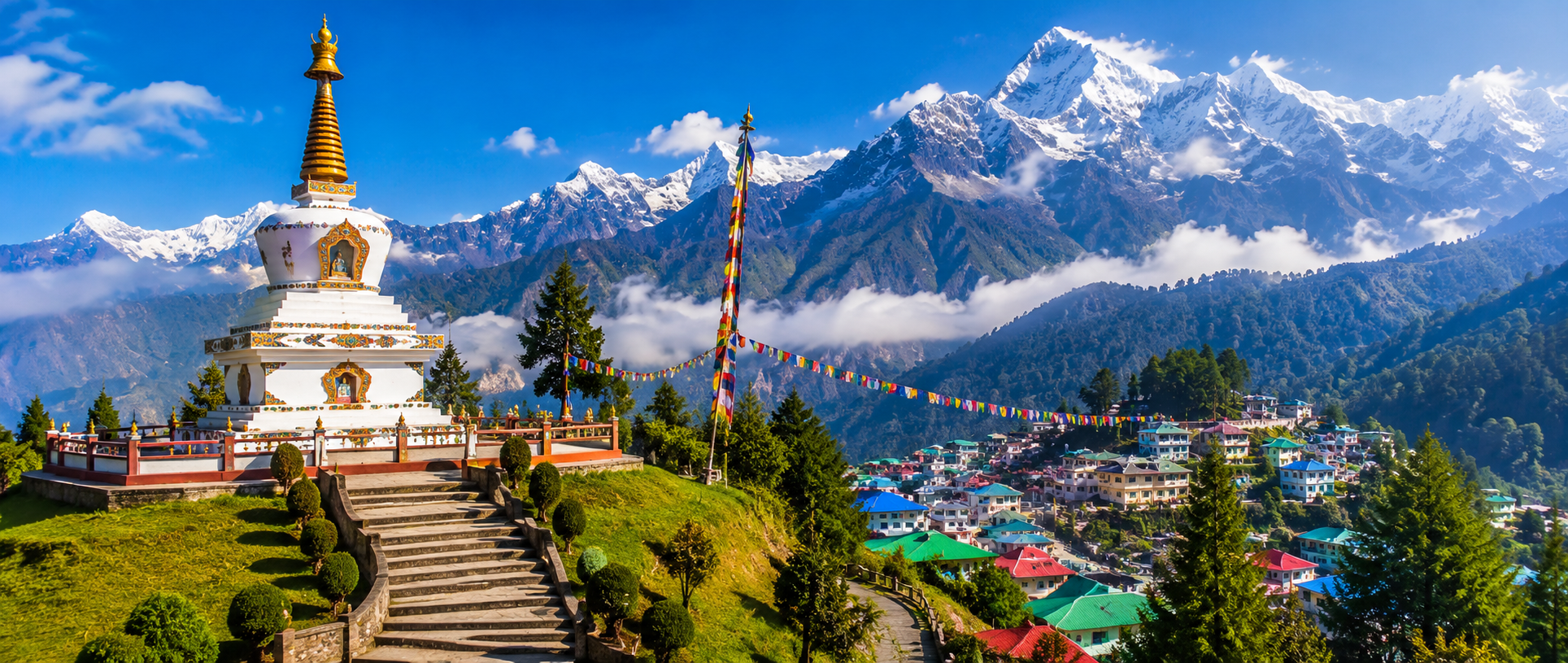
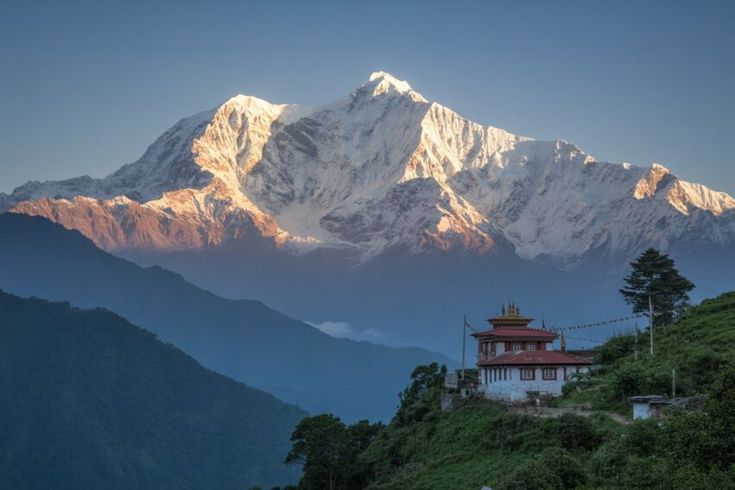
Sikkim is one of the most extraordinary Himalayan destinations in India, known for its snow-covered mountains, ancient Buddhist monasteries, high-altitude lakes, alpine valleys, and dramatic road journeys. Our Sikkim tour packages are designed to help travellers experience the complete diversity of the state from the busy mountain capital of Gangtok and the frozen lakes of North Sikkim to the peaceful monasteries of West Sikkim and the tea gardens of South Sikkim. Dominated by the mighty Kanchenjunga, the third-highest mountain in the world, Sikkim offers a travel experience that combines natural beauty, spirituality, adventure, and culture within a remarkably compact region.
Unlike many commercial hill stations in India, Sikkim has preserved much of its traditional Himalayan character. Prayer flags flutter across mountain passes, monasteries overlook forest valleys, and roads wind through waterfalls, cardamom plantations, rhododendron forests, and glacial rivers. The state is also one of India's cleanest and most environmentally protected destinations, with strong ecological policies and controlled tourism in many border regions. Whether you are planning a honeymoon, a family holiday, a photography trip, a trekking expedition, or an offbeat mountain road journey, Sikkim offers experiences that feel far more remote and authentic than most Himalayan circuits.
From the high-altitude beauty of Gurudongmar Lake and Yumthang Valley to the monastery towns of Pelling and Ravangla, every region of Sikkim offers a completely different landscape and atmosphere. Some travellers visit for the Silk Route road trip through East Sikkim, while others come for the Kanchenjunga Base Camp Trek, Buddhist monasteries, village homestays, or peaceful tea garden stays. At Vayable Trip, our itineraries focus on proper acclimatisation, realistic travel routes, carefully selected stays, and experiences that allow travellers to see Sikkim beyond rushed sightseeing schedules.
Explore Sikkim by Region
1. East Sikkim- East Sikkim is the gateway to the state and the most popular region for first-time travellers. Gangtok, Tsomgo Lake, Baba Mandir, Nathu La Pass, and the dramatic Zuluk Silk Route offer monasteries, mountain lakes, sunrise viewpoints, and some of the finest Himalayan road journeys in India.
2. North Sikkim- North Sikkim is the most dramatic and remote region of the state, known for Gurudongmar Lake, Yumthang Valley, Zero Point, and the alpine valleys around Lachen and Lachung. The landscape changes from pine forest to snow-covered Himalayan terrain within a few hours of driving.
3. West Sikkim- West Sikkim is famous for its close views of Kanchenjunga, ancient monasteries, sacred lakes, and trekking routes. Destinations such as Pelling and Yuksom combine history, spirituality, forest landscapes, and access to the Kanchenjunga Base Camp trekking circuit.
4. South Sikkim- South Sikkim offers a quieter and slower mountain experience with Buddha parks, monasteries, tea estates, forest villages, and panoramic Himalayan viewpoints. Namchi, Ravangla, Temi Tea Garden, and Maenam Wildlife Sanctuary are ideal for travellers seeking peaceful Himalayan landscapes away from heavy tourist crowds.
Top Tourist Attractions to Explore in Sikkim Tour Packages
1. Gangtok- Capital in the Clouds
Gangtok sits at 1,650 metres on a ridge in East Sikkim, with Kanchenjunga, the world's third-highest mountain at 8,586 metres filling the northwestern horizon on clear mornings with a presence so massive it seems impossible. As Sikkim's capital and its only significant urban centre, Gangtok is simultaneously the state's commercial hub and its cultural gateway: the Rumtek Monastery (one of the most important Kagyu monasteries in the world), the Namgyal Institute of Tibetology, the Enchey Monastery, and the Flower Exhibition Centre are all within the town's compact geography. The MG Marg pedestrian promenade lined with restaurants, shops, and mountain-facing viewpoints is the cleanest, most orderly town centre in Northeast India, and the Sikkim Government's long-standing environmental policies have kept the surrounding hillsides in a state of exceptional forest cover. Gangtok is the entry point for North Sikkim's high-altitude destinations, East Sikkim's Tsomgo Lake, and the state's dozens of Buddhist monasteries.
Gangtok is both the first and last stop on every Sikkim itinerary, and how you use it shapes the entire trip. Our customised Gangtok packages build in what most standard itineraries skip: a pre-dawn visit to Tashi Viewpoint before the tourist coaches arrive, when Kanchenjunga catches the first light and the valley below is still in shadow. A full morning at the Namgyal Institute of Tibetology one of the finest repositories of Tibetan Buddhist manuscripts and art in the world with a guided explanation of the thangkas and ritual objects. An evening at the local night market on MG Marg for momos, thukpa, and Sikkimese local brews. And a half-day drive to Rumtek Monastery with a guide who can explain the significance of the Black Hat ceremonial tradition and open the prayer hall properly. Gangtok is 125 km from Bagdogra Airport and 4 hours by road, all our packages include a shared or private transfer.
Best Time to Visit- March to May (rhododendron bloom, clear skies before pre-monsoon haze) • October to December (post-monsoon clarity, Kanchenjunga fully visible, best photography) • January to February (snow in higher areas, quiet and cold) • Monsoon (June–September) — roads can be affected by landslides but the valley is lush
Places to Visit- MG Marg • Tashi Viewpoint • Rumtek Monastery • Namgyal Institute of Tibetology • Enchey Monastery • Flower Exhibition Centre • Do-Drul Chorten Stupa • Ganesh Tok
What to Eat- Momos (Sikkimese steamed dumplings — the local version uses buckwheat flour and fillings of yak meat, pork, or vegetables) • Thukpa (noodle soup) • Tongba (millet beer drunk through a bamboo straw from a wooden vessel) • Gundruk soup (fermented leafy greens) • Phagshapa (dried pork with radish) • Sel Roti (rice flour ring bread) • Chhurpi (hard yak cheese)
Top Things to Do in Gangtok
- Tashi Viewpoint at dawn- arrive by 5:30 AM for the sunrise on Kanchenjunga before the tour buses arrive; the mountain appears to glow orange-pink for 20 minutes.
- Rumtek Monastery- 24 km from Gangtok, the seat of the Kagyu school of Tibetan Buddhism; visit the Shrine Room and the Golden Stupa containing relics of the 16th Karmapa.
- Namgyal Institute of Tibetology- the finest Tibetan Buddhist research institute outside Tibet, with a museum of rare thangkas, ritual objects, and manuscripts.
- Enchey Monastery- hilltop monastery in the town itself, beautiful morning prayer sessions at 6 AM and 4 PM; the resident lamas are welcoming to respectful visitors.
- MG Marg evening walk and local food- the pedestrian street at dusk, with momos, thukpa, and Sikkimese tongba (millet beer) at the local stalls.
- Flower Exhibition Centre (March–May)- Sikkim has 600+ orchid species; the centre showcases them at their peak during the spring bloom.
2. North Sikkim- Gurudongmar, Lachen & Lachung
North Sikkim is the most remote and most dramatically beautiful of the state's four districts -a restricted area bordering Tibet and China where the Teesta River originates and where the landscape climbs from subtropical forest at 1,500 metres to tundra and glacial terrain above 5,000 metres within a single valley system. The two primary destinations are Lachen (2,750 m) and Lachung (2,700 m) small towns at the head of two parallel valleys from which the key high-altitude sites are reached. From Lachen: the Gurudongmar Lake at 5,430 metres one of the highest lakes in the world and sacred to both Buddhists and Sikhs, believed to have been blessed by Guru Nanak during his travels and the Chopta Valley, a high-altitude meadow of extraordinary beauty. From Lachung: the Yumthang Valley (Valley of Flowers at 3,564 m) and the Zero Point at 4,993 metres, where the road ends at a permanent snowfield even in summer. The entire North Sikkim district requires a Protected Area Permit, adding a layer of exclusivity that limits daily visitor numbers and preserves the landscape's integrity.
North Sikkim is the destination where the details of planning make the greatest difference to the experience. The Gurudongmar Lake at 5,430 metres requires genuine acclimatisation travellers who go straight from Gangtok to Gurudongmar in two days without a rest day at Lachen suffer altitude sickness that ruins the experience. Our North Sikkim packages build in the acclimatisation schedule that the altitude demands: a night at Gangtok (1,650 m), a night at Lachen (2,750 m), then the Gurudongmar excursion (5,430 m) on Day 3. We handle the Protected Area Permit (required for all visitors, including Indian nationals), book accommodation in the limited guesthouses at Lachen and Lachung months ahead, and assign a driver who knows the road which beyond Lachen is a single-lane mountain track shared with army convoys.
Best Time to Visit- May to June (Yumthang rhododendron bloom — extraordinary) • October to December (post-monsoon, Gurudongmar Lake unfrozen and accessible, crystal clear skies) • January to April (Gurudongmar partially or fully frozen — beautiful but access can be restricted) • Monsoon (July–September) — some roads close, North Sikkim partially inaccessible
Places to Visit- Gurudongmar Lake • Yumthang Valley • Zero Point • Chopta Valley • Thangu Valley • Lachen • Lachung • Chungthang • Katao (restricted military area, permits occasionally available)
What to Eat- Yak meat preparations (Lachen and Lachung, yak meat dried, stewed, and in momos) • Thukpa at the guesthouse kitchens • Butter tea (po cha essential at altitude, the fat content helps with the cold) • Tongba millet beer at local establishments • Gundruk and Sinki (fermented vegetable soups) • Sel Roti with local honey
Top Things to Do
- Gurudongmar Lake (5,430 m)- depart Lachen at 4 AM, reach the lake by 8 AM before clouds build; the turquoise water against the barren Himalayan plateau is extraordinary.
- Yumthang Valley at rhododendron bloom (May–June)- the valley floor carpeted in 24 species of rhododendron from red to white to purple; the finest flower display in the eastern Himalayas.
- Zero Point (4,993 m)- the road ends at a permanent snowfield 23 km beyond Yumthang; snow-capped peaks on three sides, open to visitors June to November.
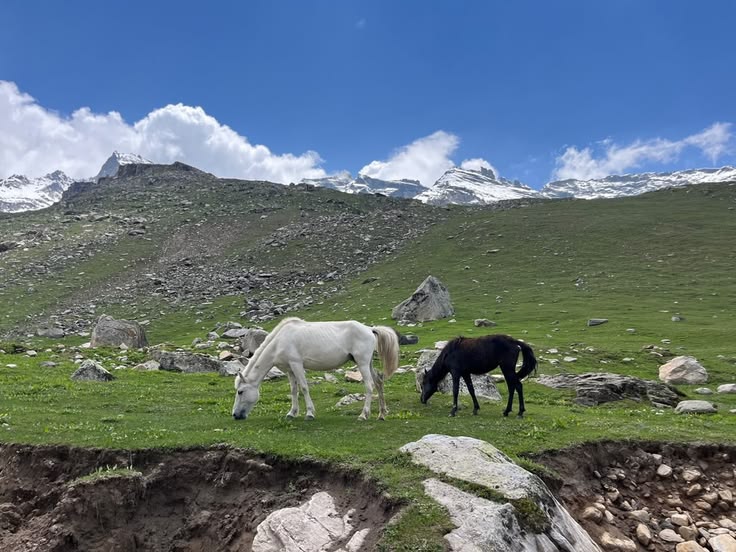
- Chopta Valley from Lachen- a high-altitude meadow at 3,400 m, far less visited than Yumthang, with views across the Kanchenjunga range and yak herds grazing.
- Thangu Valley- a broad glacial valley above Lachen at 3,600 m with small monasteries and extraordinary Himalayan views, rarely included in standard itineraries.
- Monastery visits in Lachen and Lachung- the small gompas in both towns are beautifully decorated and welcoming; the Lachen monastery has a resident oracle.
3. Tsomgo Lake & Baba Mandir- East Sikkim's Sacred High
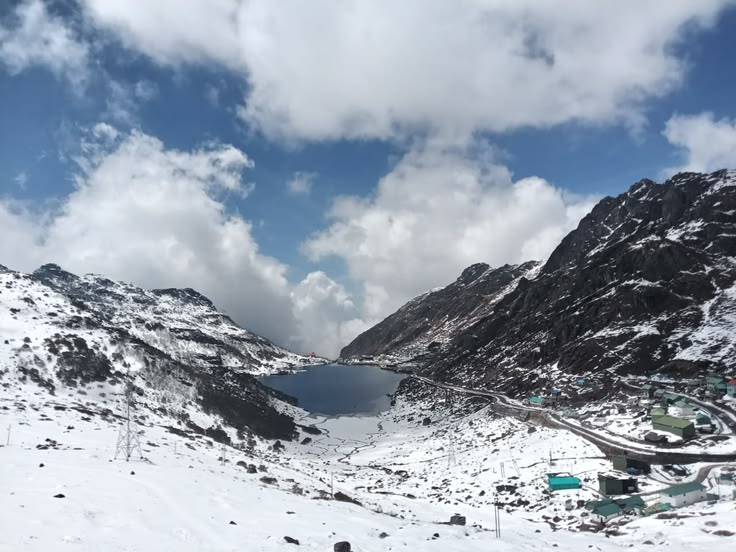
Tsomgo Lake also written Changu Lake sits at 3,753 metres, 40 kilometres east of Gangtok on the old trade route to Tibet, and is the most accessible high-altitude lake in Sikkim for day visitors from the capital. The oval glacial lake, 1 kilometre long, sits in a bowl of bare rock and short alpine grass that turns golden in autumn and white in winter the lake itself partially or fully freezes between December and March, creating a surface that reflects the surrounding peaks in a mirror of ice. Tsomgo is sacred to the local Sikkimese: the name means "source of the lake" in Bhutia, and the migratory Brahmin ducks that visit each winter are considered auspicious. The Baba Harbhajan Singh Mandir, 12 kilometres beyond Tsomgo at 4,310 metres, is a shrine to Harbhajan Singh an Indian Army soldier who died in 1968 and is believed to continue guarding the border; it is venerated by Indian Army soldiers and civilians alike and sits at one of the most dramatic viewpoints in East Sikkim.
Tsomgo and Baba Mandir are almost always done together as a single day trip from Gangtok which is the right approach if the permit and timing are managed properly. The Restricted Area Permit for the Tsomgo-Baba Mandir route is mandatory (for all nationalities including Indian), requires a passport or Aadhaar, and must be arranged the day before through a registered travel agent which we handle for all guests. We depart Gangtok by 7 AM to reach Tsomgo Lake before the coach-tour crowds (which arrive between 10 AM and 2 PM), giving 90 minutes of near-solitude at the lake. The Baba Harbhajan Singh Mandir stop in the early afternoon has the best light for photography of the Nathu La mountain backdrop. For guests who want to go further, we add the Kupup Valley (Lake of Eagles) a restricted area beyond Baba Mandir with extraordinary bird life.
Best Time to Visit- October to February (lake partially frozen, snow on the peaks, extraordinary winter scenery) • March to May (thaw, Brahmin ducks present) • June to September (monsoon the route is often closed by landslides) • Best avoided on weekends and Indian public holidays when crowds are very large
Places to Visit- Tsomgo Lake • Baba Harbhajan Singh Mandir • Nathu La Pass (Indian nationals only) • Kupup Valley • Gnathang Valley • Lungthung
What to Eat- Hot noodle soup (Maggi or thukpa) at the Tsomgo lakeside stalls eating at 3,753 m in the mountain air • Butter tea at Baba Mandir (served free to all visitors by the army canteen) • Momos from the roadside stalls • Carry packed lunch from Gangtok for the best experience
Top Things to Do
- Tsomgo Lake at dawn- arrive by 9 AM before the day-trip coaches from Gangtok; walk the circuit of the lake (2 km) before the crowds arriveYak ride at Tsomgo a short yak ride around the lake is one of Sikkim's most popular tourist experiences; the yaks are well-cared for and the riders are local families.
- Baba Harbhajan Singh Mandir at 4,310 m- the army shrine with views of the Nathu La peaks and the glacial terrain beyond; the atmosphere is genuinely affecting.
- Kupup (Lake of Eagles) beyond Baba Mandir, restricted but accessible with special permit; a high-altitude lake surrounded by mountains, the finest birdwatching spot in East Sikkim.
- Nathu La Pass view (17 km from Tsomgo) the 4,310 m pass to China, open to Indian nationals with additional permit (not available to foreign nationals); the border is a dramatic sight.
- Alpine wildflower walk in May and June the meadows around Tsomgo are covered in primulas, gentians, and anemones; a short walk beyond the main lake area finds the quieter flower patches.
4. Pelling- Kanchenjunga Up Close
Pelling sits at 2,150 metres in West Sikkim, and its defining feature is a view of Kanchenjunga that is closer, more unobstructed, and more overwhelming than anywhere else in the state. From the upper reaches of Pelling, the mountain's three summits and the long ridgeline that connects them fill the entire northern horizon from first light to sunset in a way that stops conversation. West Sikkim is the district that contains some of Sikkim's oldest and most historically significant monasteries: Pemayangtse Monastery (one of the oldest in Sikkim, founded 1705), Sangachoeling Monastery (the second-oldest, only accessible by a 30-minute forest trek), and Tashiding Monastery (the holiest monastery in Sikkim, according to Guru Padmasambhava's designation). The Khecheopalri Lake considered the wish-fulfilling lake, sacred to both Buddhists and Hindus, and unique for the fact that no leaf is ever allowed to rest on its surface (birds remove them) is 26 kilometres from Pelling and one of Sikkim's most spiritually atmospheric sites.
Pelling is the Sikkim destination that most standard Gangtok-centric packages rush through in a single day. Our Pelling itineraries allocate 2 nights enough time for a proper sunrise at the Kanchenjunga viewpoint at 5 AM, a full morning at Pemayangtse Monastery with the extraordinary Zangdog Palri (a seven-storey wood-and-papier-mâché model of Guru Padmasambhava's paradise) in the upper shrine room, an afternoon at Rabdentse Ruins (the second capital of the Chogyal kingdom), and a day trip to Khecheopalri Lake and Tashiding Monastery. The Pelling–Yuksom–Dzongri trek begins at Yuksom, 26 km from Pelling, the trek base for the Kanchenjunga Circuit, one of the Himalayas' great multi-day routes.
Best Time to Visit- October to December (clearest Kanchenjunga views, post-monsoon, ideal weather) • March to May (rhododendron bloom on the monastery trails, good visibility) • Monsoon (June–September) Kanchenjunga hidden in clouds but the forests are extraordinary
Places to Visit- Pemayangtse Monastery • Rabdentse Ruins • Khecheopalri Lake • Sangachoeling Monastery • Tashiding Monastery • Skywalk Glass Bridge • Norbugang Coronation Park • Rimbi Waterfall
What to Eat- Sikkimese Thali at local homestays (the best food in Pelling is in the family-run guesthouses) • Gundruk soup • Chhurpi (hard yak/cow cheese, chewed as a snack) • Sel Roti with tea • Kinema curry (fermented soybean preparation, a Sikkim staple) • Pork preparations at local restaurants • Tongba millet beer
Top Things to Do
- Kanchenjunga sunrise viewpoint from Pelling, position yourself at the viewpoint above the Norbugang Park by 5 AM; the mountain turns from grey to gold to white over 45 minutes.
- Pemayangtse Monastery one of Sikkim's oldest monasteries (1705), the upper shrine room contains the Zangdog Palri a seven-storey model of Guru Rinpoche's paradise that took the head lama five years to complete.
- Rabdentse Ruins, the second capital of the Chogyal kingdom, a 30-minute uphill walk through cardamom forest from Pemayangtse; the ruins overlook a valley with Kanchenjunga behind.
- Khecheopalri Lake (26 km) the wish-fulfilling lake where no leaf rests on the surface; circumambulate the lake on the forest path as pilgrims do, and watch the birds remove leaves from the water.
- Sangachoeling Monastery (30-minute trek)- the second-oldest monastery in Sikkim, only accessible on foot through forest; the prayer hall is beautifully painted and rarely crowded.
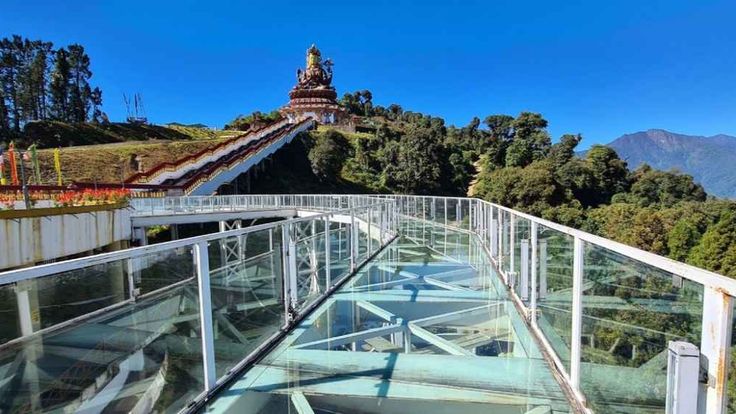
- Skywalk Glass Bridge (Pelling)- one of India's longest glass-floored suspension bridges, 100 metres above the valley, with a direct view of Kanchenjunga.
5. Yuksom- Gateway to Kanchenjunga Base Camp
Yuksom holds a unique place in Sikkim's history: it was the first capital of the Chogyal kingdom and the site where the first king of Sikkim, Phuntsog Namgyal was crowned in 1642 by three lamas who had converged there from Tibet, Bhutan, and Sikkim. The Norbugang Coronation Throne, a moss-covered stone seat in the forest, marks the exact coronation spot and is one of the most evocative historical monuments in the eastern Himalayas. At 1,780 metres in West Sikkim, 35 kilometres from Pelling, Yuksom is also the departure point for the Kanchenjunga Base Camp Trek one of the Himalayas' finest high-altitude routes, passing through rhododendron forests, yak pastures, and glacial terrain to Dzongri (4,020 m) and Goecha La (4,940 m) with the full Kanchenjunga massif visible from the ridge. The Khangchendzonga National Park, which the trek passes through entirely, is a UNESCO World Heritage Site.
Yuksom is a destination that works at two completely different levels: as a half-day heritage visit from Pelling (the Norbugang Coronation Throne, the Dubdi Monastery, and the Kathok Lake), or as the base for a 10–14 day Kanchenjunga trek. Our Yuksom packages cover both. For non-trekkers: a day trip from Pelling with a guide who can explain the coronation ceremony and the architecture of Dubdi Monastery (Sikkim's oldest, founded 1701, a 30-minute uphill walk). For trekkers: fully supported Kanchenjunga Base Camp treks with all permits (Kanchenjunga National Park permit + Protected Area Permit required), porter and guide, and accommodation in the trekking lodges that have been developed along the route. The Dzongri viewpoint (4,020 m), 4 days from Yuksom, gives the finest close view of the full Kanchenjunga range available without technical climbing.
Best Time to Visit- April to May (rhododendron bloom on the trek route, clear pre-monsoon) • October to November (post-monsoon clarity, best mountain views, stable weather on the ridge) Monsoon (June–September), Kanchenjunga Base Camp trek suspended, park partially closed
Places to Visit- Norbugang Coronation Throne • Dubdi Monastery • Kathok Lake • Khangchendzonga National Park • Dzongri • Goecha La • Samiti Lake • Tsokha
What to Eat- Trekker's trail food- Yuksom's lodges serve excellent dal bhat and thukpa • Sikkimese Thali at the family guesthouses • Butter tea at the monastery • Chhurpi and dried yak meat (trail snacks) • Sel Roti • Fresh bamboo shoot preparations
Top Things to Do
- Norbugang Coronation Throne- the 1642 coronation site of Sikkim's first king, surrounded by ancient trees and centuries-old prayer flags.
- Dubdi Monastery- Sikkim's oldest monastery (1701), 30-minute uphill walk from Yuksom through cardamom and oak forest.
- Kanchenjunga Base Camp Trek (10–14 days)- departs Yuksom, through Sachen, Tsokha, Dzongri, Thangsing, and Samiti Lake to Goecha La viewpoint at 4,940 m.
- Dzongri viewpoint (4 days from Yuksom)- the finest panoramic view of Kanchenjunga's full massif available to non-technical trekkers; worth the trek even without going to Goecha La
- Kathok Lake walk- 1-hour forest walk from Yuksom town to a small sacred lake with a monastery on the bank.
- Khangchendzonga National Park birding- the park's lower reaches around Yuksom are excellent for Himalayan species including Satyr Tragopan, Blood Pheasant, and Fire-tailed Sunbird.
6. Namchi- South Sikkim's Spiritual Skyline
Namchi is the headquarters of South Sikkim district, sitting at 1,675 metres on a ridge that gives 360-degree views of the surrounding Himalayan ranges on clear days. It is home to two of Sikkim's most visually dramatic modern religious monuments: the Samdruptse an 87-foot statue of Guru Padmasambhava (Guru Rinpoche) on a forested hilltop that is the tallest statue of the Guru in the world, and the Siddhesvara Dham a complex that replicates all 12 Jyotirlinga shrines of Shiva in a single location on Solophok Hill, making it a pilgrimage destination for Hindus who cannot travel to all 12 individual sites across India. The combination of Buddhist and Hindu sacred sites in a single hilltop town reflects Sikkim's remarkable tradition of multi-faith coexistence. The surrounding South Sikkim countryside cardamom plantations, terraced rice fields, small monasteries, and rhododendron forest makes it one of the state's most visually varied districts for slow travel.
Namchi is typically skipped by standard Gangtok packages because it is in South Sikkim a district that most tour operators don't bother with. Our Namchi packages include it as a 1–2 night stop on a South Sikkim circuit that also covers Ravangla (with its Buddha Park and tea estates), Temi Tea Garden (Sikkim's only tea estate and one of the finest in the Himalayas), and the Borong hot springs. Namchi also gives access to the Tendong Hill trek- a 3-hour forest climb to a hilltop that Sikkimese legend says saved the kingdom from a great flood, with a small Lepcha shrine at the summit and panoramic views of South Sikkim's valleys.
Best Time to Visit- October to December (clear views, post-monsoon) • March to May (wildflowers on the hillside, spring atmosphere) • Loosong festival (December–January, Sikkimese New Year) colourful Cham dance performances at the monasteries
Places to Visit- Samdruptse • Siddhesvara Dham • Temi Tea Garden • Tendong Hill • Borong Hot Springs • Ravangla Buddha Park • Maenam Wildlife Sanctuary • Ralong Monastery
What to Eat- Temi Tea (single-estate organic Himalayan tea, one of India's finest — buy directly from the estate) • Sikkimese Thali with Kinema curry • Sel Roti • Momos with Sikkimese chilli sauce • Phagshapa pork • Churpi with chilli • Bamboo shoot preparations
Top Things to Do
- Samdruptse Guru Rinpoche Statue- the 87-foot statue at the hilltop is illuminated at night; visit at sunrise for the statue against the Himalayan backdrop
- Siddhesvara Dham (Solophok Hill)- all 12 Jyotirlingas replicated in one complex; significant for Hindu pilgrims and architecturally impressive for all visitors
- Temi Tea Garden (15 km)- Sikkim's only tea estate, at 1,500 m, producing some of India's finest organic teas; walk the tea rows and visit the factory
- Tendong Hill trek (2 hours uphill)- sacred Lepcha hill with a small shrine at the summit, forest trail through rhododendron and oak, panoramic views of South Sikkim
- Borong Hot Springs (30 km)- natural sulphur hot springs in a forest setting, one of Sikkim's most relaxing half-day excursions
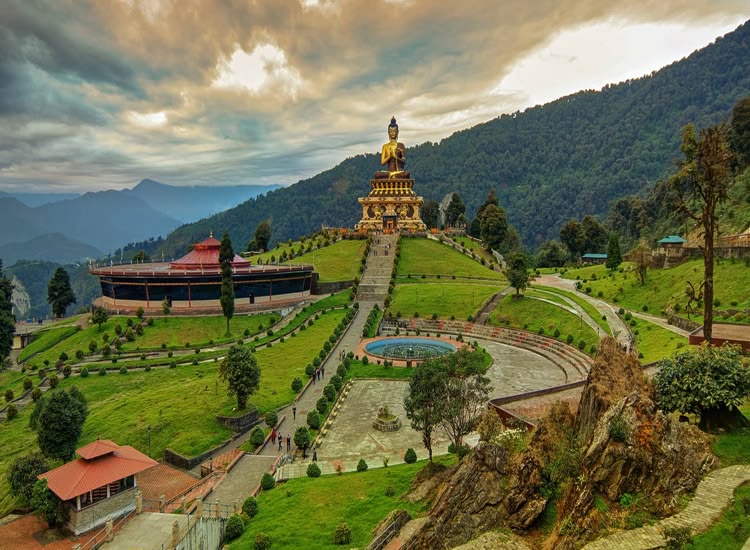
- Ravangla Buddha Park (30 km)- a 130-foot Buddha statue overlooking the Maenam Wildlife Sanctuary and the Kanchenjunga range
7. Ravangla-Tea, Buddha, and the Maenam Ridge
Ravangla sits at 2,100 metres on the ridge between the Rangit and Teesta valleys in South Sikkim, with views that take in both the Kanchenjunga massif to the north and the forested ridges descending to the plains to the south. It is the kind of place that rewards the traveller who lingers: the Buddha Park's 130-foot Shakyamuni Buddha sits against a backdrop of rhododendron-covered Maenam Hill; the Ralong Monastery behind the town is one of West Sikkim's finest; and the Maenam Wildlife Sanctuary above the town — a 3-hour uphill trek to the Maenam summit at 3,235 metres has some of the finest Red Panda habitat in Sikkim. Ravangla is quieter than Gangtok and Pelling, less touristically developed, and closer to the rhythm of Sikkimese village life. The nearby Borong and Damthang areas have homestays that offer the most authentic rural Sikkim accommodation available.
Ravangla is the destination we recommend to travellers doing a second visit to Sikkim who want to go beyond the standard circuit, or to travellers seeking an unhurried mountain experience without the infrastructure of Gangtok or Pelling. Our Ravangla packages are built around the Maenam trek (one of the finest day treks in Sikkim), a morning at the Buddha Park before the tour groups arrive from Gangtok, a visit to the Temi Tea Garden, and a sunset from the Doling Monastery above the town. We pair Ravangla with Namchi (30 km) and Pelling (45 km) for a complete South-West Sikkim circuit that most travel companies have never designed.
Best Time to Visit- October to December (clearest mountain views, Red Panda most active) • March to May (rhododendron on Maenam, spring bird activity) • Monsoon (June–September) Maenam trek trail is very slippery, Red Panda visible but trek difficult
Places to Visit- Buddha Park • Maenam Wildlife Sanctuary • Ralong Monastery • Doling Gompa • Temi Tea Garden • Borong • Damthang • Kewzing village
What to Eat- Sikkimese Homestay Thali, Ravangla's homestays serve the most authentic home-cooked Sikkimese food in the state • Kinema curry (fermented soybean) • Gundruk soup • Bamboo shoot sabzi • Pork with radish • Tongba millet beer • Temi Tea
Top Things to Do
- Maenam Wildlife Sanctuary trek (6 km uphill, 3–4 hours)- through rhododendron and oak forest to 3,235 m; Red Panda, Satyr Tragopan, and Himalayan views from the top.
- Buddha Park at dawn- the 130-foot Shakyamuni Buddha at 6:30 AM before tour coaches arrive; the mountain backdrop at this hour is extraordinary.
- Ralong Monastery- a well-maintained monastery with excellent traditional art; the annual Cham dance festival in October/November is one of South Sikkim's finest cultural events.
- Temi Tea Garden (15 km)- walk the tea estate at dawn when the pickers are working and buy fresh organic tea directly from the factory.
- Red Panda spotting in the Maenam buffer zone dawn and dusk are the best sighting windows; guided walks with local naturalists available.
- Doling Gompa sunset- the small monastery above Ravangla town gives the finest sunset view of the Kanchenjunga range from South Sikkim.
8. Zuluk & Silk Route- East Sikkim's Hidden Highway
The Zuluk Silk Route is one of the most dramatic road journeys in India, a series of 32 hairpin bends visible from a single viewpoint at Thambi, ascending from 2,500 to 3,430 metres through East Sikkim's rhododendron forests on the ancient trade route that once connected India and Tibet through the Jelep La pass. Zuluk village itself, at 2,900 metres, is a small settlement of a few dozen houses with views across the Kanchenjunga range and the Singalila Ridge that are extraordinary in scope. The circuit continues to Gnathang Valley (3,640 m) a high-altitude grassland with army settlements and yak herds and Nathang Valley, before connecting to Tsomgo Lake on the return to Gangtok. The entire route requires a Protected Area Permit and is accessible only through registered agents with specified vehicles; this restriction limits daily visitor numbers and has preserved the route's wild character.
The Zuluk Silk Route is Sikkim's most distinctive road trip and one of the least-known dramatic journeys in the eastern Himalayas. Most travel companies are not licensed for the protected area or do not know the route well enough to plan it properly. Our Zuluk packages include a 2-night stay at Zuluk (necessary to see the 32-hairpin viewpoint at Thambi both at dawn and sunset, which give completely different atmospheres) with accommodation at the limited guesthouses that have been licensed to operate in the area. We design the circuit as a 3-day loop from Gangtok Day 1 to Zuluk via Rongli and Aritar, Day 2 Zuluk–Gnathang–Nathang, Day 3 Nathang–Tsomgo–Gangtok giving a complete East Sikkim high-altitude experience that pairs naturally with the North Sikkim circuit for a 7-night Sikkim trip.
Best Time to Visit- October to December (post-monsoon clarity, best views, Kanchenjunga fully visible) • March to May (rhododendron bloom along the route) • Road is typically closed January to February due to heavy snowfall • Monsoon (June–September) — route often blocked by landslides
Places to Visit- Zuluk Village • Thambi Viewpoint • Gnathang Valley • Nathang Valley • Lungthung • Aritar Lake • Old Silk Route • Jelep La (border, restricted) • Kupup
What to Eat- Simple guesthouse food at Zuluk- dal bhat, thukpa, and momos from the family kitchens • Butter tea and Tongba at altitude • Army canteen tea at Gnathang (open to civilian visitors) • Carry packed food from Gangtok for Nathang and Thambi viewpoint
Top Things to Do
- Thambi viewpoint at dawn- the point from which all 32 hairpin bends of the Zuluk ascent are visible simultaneously; arrive at 5:30 AM for the mist-and-sunrise experience
- Zuluk village walk- the tiny settlement at 2,900 m with a small monastery, a handful of guesthouses, and extraordinary mountain views in three directions
- Gnathang Valley- the high-altitude grassland at 3,640 m with yak herds, army settlements, and panoramic views across the Jelep La ridge
- Nathang Valley sunrise- the broad mountain valley at 3,500 m, best in the early morning when the Kanchenjunga range catches first light
- Aritar Lake (en route)- a small lake at 1,500 m surrounded by orange orchards and forest, a pleasant stop on the drive from Gangtok to Zuluk
- Lungthung viewpoint- at 3,900 m on the Silk Route, one of the highest viewpoints accessible by road in Sikkim, with views into Bhutan and China on clear days
9. Kalimpong- Art Town on the Teesta
Kalimpong sits at 1,250 metres on a ridge above the Teesta River in the Darjeeling Hills technically part of West Bengal but geographically, culturally, and historically inseparable from the Sikkim circuit. It was a major trading post on the old Tibet-India route before 1959, and that heritage is visible in the extraordinary diversity of its population: Nepali, Lepcha, Bhutia, Tibetan, Sikkimese, Bengali, and a small community descended from Scottish missionaries who built schools that are still among West Bengal's finest. Kalimpong is known for its nurseries the town produces a significant proportion of India's commercial orchid and gladioli exports and for the Thongsa Gompa and Zang Dhok Palri Phodang monasteries that preserve rare Tibetan Buddhist texts brought out of Tibet after 1959. The town's colonial-era market, the Cactus Nursery, and the riverside drive along the Teesta make it a destination of quiet, textured pleasure that contrasts sharply with Sikkim's high-altitude drama.
Kalimpong works naturally as the final stop on a Sikkim circuit before the drive to Bagdogra Airport (80 km) or as a standalone 2-night destination for travellers who want culture, art, and mild-altitude walking without the permit requirements and road complexity of North Sikkim. Our Kalimpong packages include the Zang Dhok Palri Phodang monastery's library of rare Tibetan texts, the Deolo Hill sunrise, a guided walk through the nursery district, the Morgan House (a colonial bungalow converted to a state heritage hotel), and the Cactus Nursery which has become a genuine destination for plant lovers. We pair Kalimpong with Lava and Rishyap (40 km away in the Neora Valley forest) for guests who want an offbeat forest escape that almost no travel company covers.
Best Time to Visit- October to April (dry, clear views of Kanchenjunga from Deolo Hill) • Spring (March to April) — the nurseries are in full bloom • Monsoon (June–September) — the Teesta swells dramatically and the hills are lush but roads can be affected
Places to Visit- Deolo Hill • Zang Dhok Palri Phodang • Thongsa Gompa • Kalimpong Nurseries • Morgan House • Durpin Monastery • Lava • Neora Valley National Park • Teesta River
What to Eat- Kalimpong Cheese (the town produces a cow's milk cheese using a Swiss recipe introduced by missionaries sold at the market) • Shapale (fried meat-filled bread) • Sael (rice ring bread) • Beef preparations at local restaurants • Chow Mein Kalimpong-style (different from Chinese or Indian versions) • Tongba • Aachar (local pickles)
Top Things to Do
- Deolo Hill sunrise (1,704 m)- the highest point in Kalimpong with views of Kanchenjunga, the Teesta Valley, and the plains; arrive at 5:30 AM for the finest light.
- Zang Dhok Palri Phodang- houses one of the most significant collections of Tibetan Buddhist texts outside Tibet; the library is accessible to respectful visitors.
- Kalimpong Nurseries- the orchid and cactus nurseries on the slopes are open to visitors; the Himalayan Hotel's nursery and the ITC Research Station are the finest.
- Thongsa Gompa (Bhutanese Monastery)- the oldest monastery in Kalimpong (1692), with an important collection of religious art brought from Bhutan.
- Lava and Neora Valley National Park (40 km)- a dense temperate forest at 2,350 m with Red Panda and over 300 bird species; the finest birding destination in the Darjeeling-Sikkim region.
- Teesta River walk- the riverside drive below Kalimpong follows one of the Himalayas' most beautiful rivers through a gorge of extraordinary depth and colour.
10. Kanchenjunga Base Camp Trek- The Ultimate Sikkim Circuit
The Kanchenjunga Base Camp Trek is one of the great Himalayan trekking routes, a 10 to 14-day journey from Yuksom through the Khangchendzonga National Park (UNESCO World Heritage Site) to Goecha La at 4,940 metres, from where the full south face of Kanchenjunga (8,586 m) fills the view from summit to glacier in a wall of ice and rock that rivals anything in the Himalayas. The route passes through some of the most dramatic ecological transitions in the eastern Himalayas: subtropical forest at Yuksom gives way to temperate oak and rhododendron forest at Tsokha, then to alpine meadow and yak pasture at Dzongri, and finally to glacial moraines and snowfields at Zemathang and Samiti Lake. The Dzongri Plateau at 4,020 metres, four days from Yuksom is itself a destination of extraordinary beauty, with a 360-degree panorama of Kanchenjunga, Pandim, Rathong, and Kabru peaks that most trekkers consider the finest mountain viewpoint in the eastern Himalayas.
The Kanchenjunga Base Camp Trek is more demanding than any other route in this content pack, it requires a minimum of 10 days, a Protected Area Permit plus Kanchenjunga National Park permit (which we arrange), good fitness and cold tolerance, and a willingness to sleep at altitude with basic trekking lodge facilities. What it delivers in return is a mountain experience that fewer than 3,000 trekkers complete per year, making it simultaneously one of the Himalayas' finest and least-crowded major routes. Our Kanchenjunga Base Camp packages are fully supported: permits, guide, porter, trekking lodge bookings (capacity is extremely limited at Dzongri and Goecha La camps), and a pre-trek orientation briefing. We also offer a shorter Dzongri Viewpoint option (6 days return from Yuksom) for trekkers with limited time who still want the best mountain views on the route.
Best Time to Visit- April to May (rhododendron forest in bloom on the lower route, pre-monsoon stable weather) • October to November (post-monsoon, clearest skies, best views at Goecha La, cold but stable) • Monsoon (June–September)- route closed due to landslides and park regulations • Route closed November to March (heavy snow at altitude)
Places to Visit- Yuksom • Sachen • Tsokha • Dzongri Plateau • Thangsing • Samiti Lake • Goecha La • Zemathang • Bakkhim Meadow
What to Eat- Trekking lodge dal bhat (the standard trail meal- rice, lentils, potato sabzi and pickle, served twice daily at the lodges) • Sherpa stew (thick vegetable and noodle soup) • Garlic soup (essential at altitude for acclimatisation) • Butter tea • Tsampa (roasted barley flour) porridge at high camps • Carry chocolate and energy bars for the Goecha La summit day
Top Things to Do
- Goecha La viewpoint (4,940 m)- the closest non-technical viewpoint to the Kanchenjunga south face; the scale of the mountain from this point has to be seen to be understood.
- Dzongri Plateau sunrise (4,020 m)- the 360-degree panorama of the Kanchenjunga massif, Pandim, and the surrounding peaks at dawn; even without going to Goecha La, this viewpoint justifies the trek.
- Samiti Lake camp (4,200 m)- the final night before Goecha La, a glacial lake at the foot of Kanchenjunga's south wall; camping here with the stars and the glacier is extraordinary.
- Rhododendron forest passage (Tsokha to Dzongri)- in April and May, the forest is covered in 15+ species of rhododendron from scarlet to cream; one of the finest flower experiences in the Himalayas.
- Bakkhim meadow- a grassy plateau at 3,065 m on Day 3, one of the finest lunch stops on the route with panoramic views and reliable Red Panda habitat.
- Yuksom to Sachen- the first day's walk through subtropical forest along the Rathong River, with waterfalls, orchids, and cardamom plantations; the botanical diversity is extraordinary before the altitude begins.
Adventure Activities in Sikkim Tour Packages
Sikkim is one of India’s most exciting Himalayan adventure destinations, where snow-capped mountains, alpine lakes, dense forests, and high-altitude valleys create the perfect setting for thrilling outdoor experiences. From challenging treks and river adventures to snow activities and scenic mountain exploration, Sikkim offers unforgettable adventures for every kind of traveller.
• Trekking to Goechala Trek- one of India’s most scenic Himalayan treks with breathtaking views of Kanchenjunga and surrounding peaks.
• River rafting in the Teesta River- thrilling white-water rafting experiences through fast-flowing Himalayan rivers and deep valleys.
• Paragliding in Gangtok- fly above mountain valleys, monasteries, forests, and scenic landscapes of East Sikkim.
• Camping in Yumthang Valley- overnight stays amidst alpine meadows, rivers, and snow-covered Himalayan surroundings.
• Snow adventures near Tsomgo Lake- snow walks, snow play, and winter experiences in high-altitude mountain regions.
• Mountain biking through Himalayan roads- cycling adventures across winding mountain roads, villages, and scenic valleys.
• Exploring Gurudongmar Lake- high-altitude expeditions to one of the world’s highest lakes surrounded by dramatic mountain landscapes.
• Yak rides in North Sikkim- traditional mountain experiences near alpine lakes and snow-covered regions.
• Nature walks and forest trails in Yumthang Valley– peaceful hiking experiences through rhododendron forests and Himalayan meadows.
• Ropeway rides in Gangtok- panoramic aerial views of the city, valleys, and snow-clad mountain ranges.
• Birdwatching and wildlife exploration- spotting rare Himalayan birds and wildlife in Sikkim’s protected forests and sanctuaries.
• Sunrise excursions to mountain viewpoints- witnessing breathtaking Himalayan sunrise views over the Kanchenjunga range.