8988133331
Home/Packages/ Karnataka Tour Packages
Destination
Where To?
Check-in
Check-out
Guests

1 R. 2 Ad. 0 Ch.

Karnataka Tour Packages

Karnataka is one of the most diverse travel destinations in India, a state where ancient empires, coffee-covered hills, wildlife forests, sacred temples, and untouched Arabian Sea beaches exist within a single journey. From the royal grandeur of Mysore and the ruined magnificence of Hampi to the misty estates of Coorg and the coastal beauty of Gokarna, Karnataka offers experiences that appeal to every kind of traveller. Our Karnataka tour packages are designed to help you explore the state's finest destinations with carefully planned itineraries, comfortable stays, and authentic local experiences.

What makes Karnataka unique is the sheer variety packed into one state. You can begin your morning inside a 1,000-year-old temple, spend the afternoon spotting elephants on a Kabini safari, and end the day watching the sunset over the Arabian Sea in Gokarna or Udupi. Karnataka is also home to UNESCO World Heritage Sites, the birthplace of India's coffee culture, some of South India's finest temple architecture, and one of the country's richest culinary traditions.

Whether you are planning a heritage journey through Hampi and Badami, a relaxing hill station escape in Coorg and Chikmagalur, a wildlife adventure in Nagarhole and Dandeli, or a coastal road trip along the Karnataka shoreline, Vayable Trip offers customised Karnataka holidays for families, couples, groups, and solo travellers. With handpicked stays, local expertise, and flexible itineraries, we help you experience Karnataka beyond the ordinary.

Top Tourist Attractions to Explore in Karnataka Holiday Packages

1. Mysuru (Mysore)- The City of Palaces

Mysuru is the city that most perfectly embodies the idea of a princely state, a city of broad, tree-lined boulevards, grand public buildings, heritage hotels in former maharaja's guest houses, and at its centre the Mysore Palace: a 73,000-square-metre Indo-Saracenic masterpiece illuminated by 97,000 lightbulbs on Sunday evenings and public holidays in a spectacle that is one of India's most distinctive visual experiences. The Wadiyar dynasty that ruled Mysore for over 600 years was among the most progressive of India's princely rulers, commissioning the Krishnaraja Sagara dam (which brought electricity and irrigation to the region in 1924), building the Mysore University (1916), and supporting a tradition of silk weaving, sandalwood carving, and ivory inlay that made Mysore crafts famous across the world. The Dasara festival 10 days of processions, cultural performances, and the illumination of the palace is the most celebrated royal festival in South India and transforms the city each October into one of the most spectacular events in Indian tourism.

Best Time to Visit- October to March (finest weather) • October (Dasara book 6 months ahead; palace illumination and procession are the centrepiece) • January (Mysore Flower Show at Brindavan Gardens) • avoid April to June (hot and dry).

Places to Visit- Mysore Palace • Devaraja Market • Chamundeshwari Temple • Brindavan Gardens • Mysore Zoo • St. Philomena's Cathedral • Lalitha Mahal Palace • Srirangapatna • Somnathpur • Ranganathittu Bird Sanctuary.

What to Eat- Mysore Pak • Mysore Masala Dosa (the Mysore version with a red chilli and garlic chutney spread inside the dosa) • Mysore Sandal Soap • Akki Rotti • Thatte Idli • Filter Coffee.

Top Things to Do

  • Mysore Palace Sunday illumination- the 97,000 lightbulbs switching on simultaneously at 7 PM; arrive by 6:30 PM for position.
  • Mysore Palace interior (daily)- the Ambavilasa hall, the Kalyana Mantapa, and the collection of gold howdah and royal artifacts; hire the official audio guide.
  • Devaraja Market at dawn- the oldest market in Mysore at 5 AM; the jasmine garland traders, the sandalwood oil sellers, and the silk merchants.
  • Mysore Silk Weaving Cooperative- the government-run silk cooperative where Mysore crepe silk saris are woven.
  • Somnathpur Hoysala Temple (35 km)- the finest single Hoysala temple, completely intact with over 200 metres of continuous sculptural narrative.
  • Dasara procession (October)- the 10-day festival's final procession with the golden howdah elephant carrying the goddess.

2. Hampi- The Vijayanagara Empire's Ruined Capital

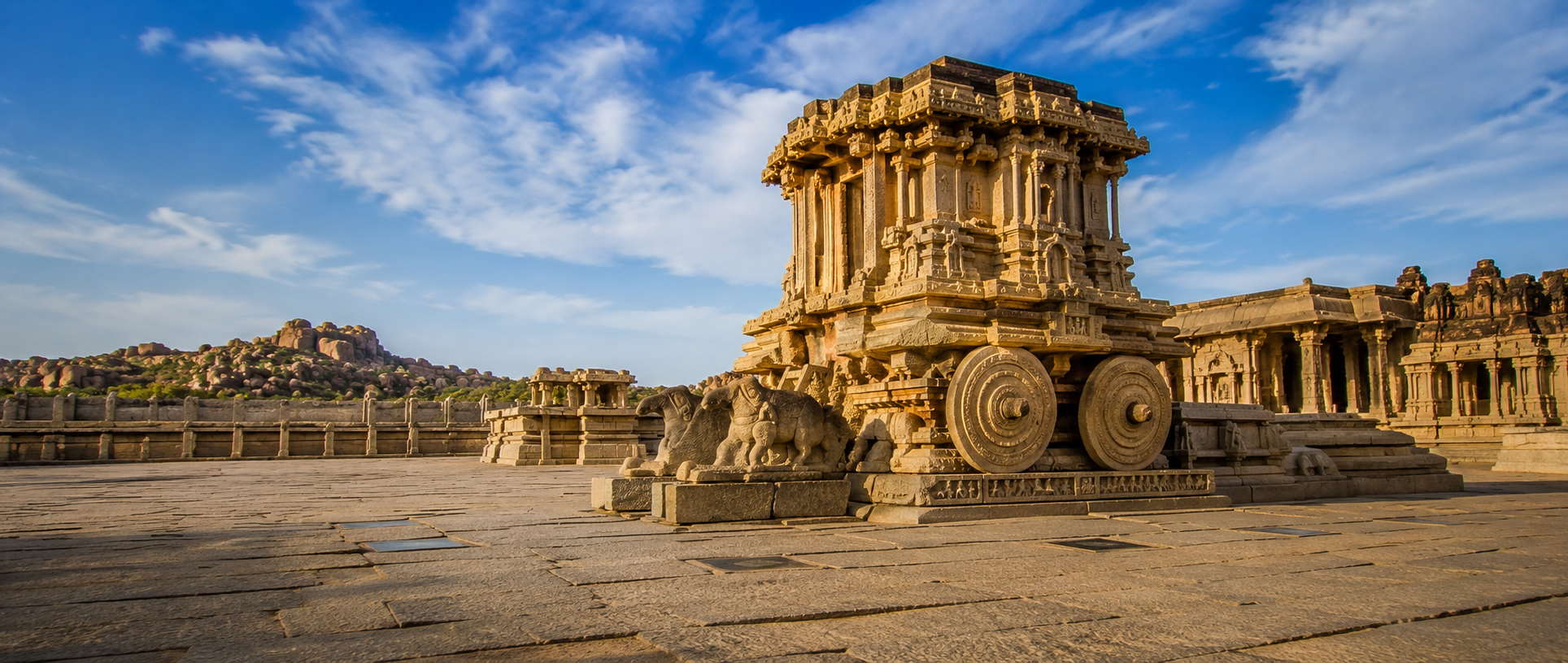
Hampi is the most extraordinary archaeological landscape in India, a UNESCO World Heritage Site where the ruins of Vijayanagara, one of the greatest empires of the medieval world, are scattered across 26 square kilometres of granite boulders on the banks of the Tungabhadra River in the Bellary district of Karnataka. At its 15th-century peak, Vijayanagara was the second-largest city in the world after Beijing, with a population of 500,000 and a trading network that extended from Portugal to China. The empire was destroyed in 1565 by the Deccan Sultanates in the Battle of Talikota, and the city was burned and abandoned, but the stone structures survived: the Virupaksha Temple (still active after 1,300 years), the Vittala Temple with its stone chariot and musical pillars, the Lotus Mahal, the Hazara Rama Temple, the Queen's Bath, and hundreds of other structures spread across a landscape of surreal beauty, the granite boulders stacked in impossible formations above the river, the paddy fields between the ruins, and the banana plantations creating a juxtaposition of the ancient and the agricultural that exists nowhere else in the world.

Best Time to Visit- October to February (ideal visiting weather, cool mornings) • November to January (the finest season, the boulders are warm in the sun, the light is extraordinary) • avoid March to May (extreme heat in the Deccan, 40–44°C) • Monsoon June to September, the river is dramatic but some monuments flood.

Places to Visit- Vittala Temple • Virupaksha Temple • Hazara Rama Temple • Lotus Mahal • Elephant Stables • Matanga Hill • Hemakuta Hill • Queen's Bath • Achutaraya Temple • Anegundi.

What to Eat- Hampi's traveller cafes • Bisi Bele Bath • Jolada Rotti • Obbattu (sweet stuffed flatbread, a Karnataka festival food) • Fresh coconut water at the ruins.

Top Things to Do

  • Vittala Temple- the stone chariot and the musical pillars (each pillar produces a different musical note when tapped); arrive at 8 AM before the crowds.
  • Matanga Hill sunrise- the steep 20-minute climb to the hilltop at 5:30 AM; the 360-degree view of the entire Hampi landscape at first light is extraordinary.
  • Virupaksha Temple at dawn puja- the active temple at the heart of Hampi, continuously worshipped for 1,300 years.
  • Coracle ride across the Tungabhadra- the circular basket boats that cross the river to Anegundi; the Anjaneya Temple on Hemakuta.
  • Hazara Rama Temple sculptural programme- the 1,000 Ramayana scenes carved on the inner walls of the royal ceremonial temple.
  • Sunset from Hemakuta Hill- the hill immediately above Virupaksha Temple; the Vijayanagara ruins spread below at golden hour is Hampi's finest photography moment.

3. Coorg (Kodagu)- Scotland of India

Coorg officially Kodagu is the most densely forested district in Karnataka and the coffee capital of India, producing 30% of the country's coffee crop on estates that cover the slopes of the Western Ghats between 900 and 1,700 metres. The district has been called the Scotland of India for its rolling green hills, mist-filled valleys, and the fierce warrior tradition of the Kodava community a people with their own distinct language, culture, and culinary tradition who maintained their independence from the Mysore sultans and were only integrated into British India in 1834. The Namdroling Monastery at Bylakuppe (40 km from Madikeri) is the largest Tibetan settlement in India outside the Himalayan region established by Tibetan refugees in 1963 and now home to 10,000 people, three extraordinary golden temples, and a way of life more closely related to Lhasa than to Karnataka. The Abbey Falls, the Raja's Seat viewpoint in Madikeri, and the Pushpagiri Wildlife Sanctuary complete a landscape that is among the most beautiful in South India.

Best Time to Visit- October to May (coffee harvest October to February, all estates operational) • October to February (finest weather, estate stays at their most atmospheric) • Monsoon June to September, the forest is extraordinary but roads affected, estates partially closed.

Places to Visit- Madikeri • Raja's Seat • Namdroling Monastery Bylakuppe • Talacauvery • Abbey Falls • Dubare Elephant Camp • Nagarhole National Park • Iruppu Falls • Brahmagiri Peak.

What to Eat- Pandi Curry • Kadambuttu • Noolputtu (string hoppers with coconut curry) • Akki Rotti.

Top Things to Do

  • Coffee estate tour at harvest season (October to February)- picking, pulping, washing, drying; the full coffee production process from cherry to cup.
  • Namdroling Golden Temple at Bylakuppe (40 km)- the largest Tibetan monastery in South India; the three golden temples and the thangka collection at dawn.
  • Talacauvery- the sacred source of the Cauvery River at 1,276 m; the Western Ghats view into Kerala from the hilltop shrine.
  • Coorg wildlife safari (Nagarhole National Park, 90 km)- the finest tiger and elephant reserve in Karnataka; morning jeep safari.
  • Kodava home cooking class- pork preparations (Pandi Curry), bamboo shoot curry, and Kadambuttu (steamed rice balls) with a local Kodava family.
  • Abbey Falls and forest walk- the 70-foot waterfall through coffee plantation forest; best in the post-monsoon when the flow is at peak.

4. Bengaluru- India's Silicon Valley and Garden City

Bengaluru (Bangalore) is India's most cosmopolitan city and the world's fifth-largest technology hub, a city of 13 million people that has grown faster than any other Indian city in the past three decades while retaining a climate (altitude 920 metres, average temperature 24°C) that is the most pleasant of any major Indian city year-round. The colonial inheritance is visible in the Cubbon Park (a 300-acre public garden at the city's centre), the Vidhana Soudha (the 1956 state legislature building in Dravidian-influenced neo-Baroque), the Bangalore Palace (1887, a Tudor-style palace modelled on Windsor Castle), and the Irish pubs and microbreweries of Indiranagar and Koramangala that reflect the city's global character. Bengaluru is also the base for the finest day trips in Karnataka: Mysore (3 hours), Hampi (6 hours), Nandi Hills (60 km), Shivanasamudra Falls (135 km), and the Bheemeshwari fishing and nature camp on the Cauvery River.

Best Time to Visit- Year-round (Bengaluru's climate is the most consistent of any Indian city) • October to February (finest weather for outdoor activities and day trips) • Monsoon July to September, the city is green and comfortable, Shivanasamudra Falls at peak.

Places to Visit- Cubbon Park • Bangalore Palace • Vidhana Soudha • Lalbagh Botanical Garden • ISKCON Temple • Visvesvaraya Museum • Nandi Hills • Shivanasamudra Falls • Bheemeshwari.

What to Eat- MTR (Mavalli Tiffin Rooms) breakfast • Bengaluru's craft beer scene (Toit, Windmills) • Bisi Bele Bath • Masala Dosa • Darshini fast-food standing restaurants • Udupi cuisine at the city's hundreds of South Indian restaurants.

Top Things to Do

  • Nandi Hills sunrise (60 km)- the 1,478-metre hilltop at dawn; the Deccan plateau spread below in the morning mist is extraordinary.
  • Cubbon Park and State Central Library walk- the 300-acre colonial garden at the city's centre; the library building is one of Bengaluru's finest colonial structures.
  • Bangalore Palace- the 1887 Tudor-style palace with the original Wadiyar furnishings and the extraordinary neo-Gothic architecture.
  • Indiranagar microbrewery evening- Bengaluru pioneered India's craft beer culture; the Toit, Windmills, and Arbor Brewing breweries.
  • Shivanasamudra Falls day trip (135 km)- the twin falls of the Cauvery River in the monsoon and post-monsoon are extraordinary.
  • Bheemeshwari Fishing Camp (100 km)- 2 nights on the Cauvery River for mahseer fishing (catch and release), coracle rides, and the finest riverside nature camp.

5. Badami, Aihole & Pattadakal- The Chalukya Cradle

The Bagalkot district of northern Karnataka contains three sites Badami, Aihole, and Pattadakal that together represent the laboratory in which the entire Dravidian and Nagara temple architectural traditions were invented and refined between the 6th and 8th centuries CE by the Chalukya dynasty. Aihole (with over 125 temples) is where the experiments began architects working in different styles simultaneously, testing structural forms that would eventually become codified. Pattadakal (UNESCO World Heritage Site) is where the finest results were assembled a single complex containing temples in both the northern Nagara and southern Dravidian styles side by side, a unique architectural conversation preserved in stone. Badami is where the Chalukya power was based a dramatic sandstone town built into a gorge above an emerald-green tank, with four rock-cut cave temples carved into the cliff face that contain the finest Chalukya sculptural programme in existence, including the 18-armed cosmic Vishnu and the earliest large-scale Nataraja carving in South India.

Best Time to Visit- October to March (ideal heritage visiting weather) • November to February (finest light on the red sandstone, comfortable walking) • avoid April to June (extreme heat in the Deccan plateau).

Places to Visit- Badami Cave Temples • Agastya Lake • Bhutanatha Temple • Pattadakal UNESCO Complex • Aihole Archaeological Site • Durga Temple Aihole • Badami Fort • Mahakuta.

What to Eat- North Karnataka cuisine • Jolada Rotti with Ennegayi (stuffed brinjal curry) • Shenga Chutney (groundnut chutney) • Bele Palya (lentil preparations) • Ragi Mudde (finger millet balls) • Local jaggery from the sugarcane fields of Bagalkot.

Top Things to Do

  • Badami Cave Temples (Caves 1–4)- the Chalukya rock-cut temples with the 18-armed Vishnu and the Nataraja; arrive at 8 AM for the best light inside the caves.
  • Agastya Lake and Bhutanatha Temple at sunset- the emerald tank below the caves reflects the cave temple complex at golden hour.
  • Pattadakal UNESCO complex- the Virupaksha and Papanatha temples showing the two great architectural traditions side by side.
  • Aihole archaeological complex- the 125+ temples in various states of completion and experimental styles; the Durga Temple (circular apsidal plan) is the finest.
  • Badami Fort and North Cliff viewpoint- the fort above the caves gives a complete view of the gorge, the tank, and the surrounding Deccan landscape.
  • Mahakuta temple cluster (20 km from Badami)- a sacred tank complex with 5th-century Chalukya temples, almost never visited.

7. Gokarna- Sacred Beach Town on the Arabian Sea

Gokarna is the destination that Goa used to be a small coastal town on the Karnataka coast, 60 kilometres south of Goa, with five beaches (Om Beach, Kudle Beach, Half Moon Beach, Paradise Beach, and the Main Beach fronting the Mahabaleshwara Temple) that range from the easily accessible to the genuinely remote, and a pace of life that reflects the town's dual identity as a significant Hindu pilgrimage site and a long-established traveller destination. The Mahabaleshwara Temple one of the most important Shiva shrines on the Karnataka coast, believed to house an original atmalinga brought from Lanka by Ravana draws pilgrims from across South India, and the town's narrow market street, lined with temples, flower sellers, and small restaurants serving the coastal Karnataka cuisine, gives Gokarna a character entirely different from Goa's resort beaches. Om Beach, named for its natural Om-shape when seen from the hill above, is the most popular of the beaches; Half Moon and Paradise, accessible only by boat or a 45-minute rocky walk, have a privacy that is rare on the western coast.

Best Time to Visit- October to March (beach season, pilgrimage weather) • November to February (finest beach conditions, calmest sea) • Maha Shivaratri (February/March) the most significant festival at Mahabaleshwara Temple, extraordinary pilgrimage atmosphere • avoid June to September (monsoon, beaches rough, some boat services suspended).

Places to Visit- Om Beach • Kudle Beach • Half Moon Beach • Paradise Beach • Mahabaleshwara Temple • Mirjan Fort • Yana Rocks • Gokarna Town • Aghanashini River.

What to Eat- Coastal Karnataka Seafood • Neer Dosa • Kane Fish Fry • Rava-Fried Prawns • Tender Coconut Water from the beach vendors • Mangalore Buns.

Top Things to Do

  • Om Beach at dawn- the natural Om-shaped beach before the beach shacks open; swim in the calm morning water before the wind picks up.
  • Half Moon and Paradise Beach by boat-  the boat from Om Beach takes 20 minutes to Half Moon and another 15 to Paradise; both are significantly less developed.
  • Mahabaleshwara Temple at dawn puja- one of Karnataka coast's most sacred Shiva temples; the atmalinga sanctum and the morning ritual.
  • Mirjan Fort (20 km north)- the 16th-century fort surrounded by forest and the Aghanashini River; the most atmospheric coastal fort on the Karnataka coast.
  • Yana Rocks (60 km inland)- towering black crystalline limestone formations in a forest; the Bhairaveshwara Cave temple inside the larger formation.
  • Gokarna market street evening- the temple town's narrow bazaar at evening with the flower sellers, the coconut oil vendors, and the pilgrims.

8. Nagarhole & Kabini- Karnataka's Tiger and Elephant Country

Nagarhole National Park and the Kabini River that forms its southern boundary constitute Karnataka's finest wildlife destination a 643-square-kilometre reserve of moist deciduous forest that shelters one of India's highest concentrations of Bengal tiger, Indian leopard, Asiatic elephant, gaur, and dholes (Indian wild dogs). The Kabini River, dammed at Kabini to create a reservoir that acts as a dry-season wildlife magnet, is the most celebrated wildlife photography location in India the winter months (October to February) when the lake level drops, the grassland around the reservoir edge turns to rich pasture, and elephants, tigers, leopards, and painted storks congregate in extraordinary density. The Kabini area has produced some of the finest wildlife photographs in Indian publishing history, and the early morning boat rides on the reservoir watching herds of elephants wade across the shallows while cormorants dive around them are among the most memorable safari experiences in India.

Best Time to Visit- October to May (park open) • October to February (finest wildlife elephants congregate at the lake edge, leopard sightings regular) • March to May (best tiger sightings  forest thins, tigers at waterholes) • Park closed June to September (monsoon).

Places to Visit- Kabini Lake • Nagarhole National Park • Kabini River Lodge • Dubare Elephant Camp • Veeranahosahalli (safari start) • Mastige Trail • Mysore (2 hours from Kabini).

What to Eat- JLR Kabini lodge dining • Coorg-influenced pork preparations at the forest-edge guesthouses • Bisi Bele Bath • Ragi Mudde with Bassaru • Fresh honey from the Nagarhole forest apiaries • Filter Coffee from the Coorg estates adjacent to the park.

Top Things to Do

  • Pre-dawn boat safari on Kabini Lake- elephant herds wading across the shallows at sunrise, painted storks, and the occasional tiger at the water's edge.
  • Nagarhole jeep safari- the sal and teak forest zone; gaur, dholes, and leopard are the headline species alongside tiger.
  • Waterhole vigil (evening)- parked at a waterhole in the buffer zone at dusk; tiger sightings at the waterhole in the last hour of light.
  • Crocodile and bird watch on the reservoir- the Kabini reservoir supports marsh crocodiles, Indian skimmer, and large concentrations of migratory ducks in winter.
  • Elephant interaction at Dubare Camp (near Coorg)- the state forest department's elephant camp where the working elephants are bathed and fed each morning.
  • Coorg-Kabini circuit- the 90 km drive from Madikeri to Kabini through coffee estate country.

9. Mangaluru (Mangalore)- Coastal Karnataka's Food Capital

Mangaluru is the capital of the Tulu-speaking coastal Karnataka belt a city of 500,000 on the Arabian Sea coast, 350 kilometres from Bengaluru, that has been a significant port since the Arab trading era and whose culinary tradition (Tulu Nadu cuisine, distinct from both Goa and Kerala) is one of the most complex and least-known in India. The Mangaluru Bunt community's fish and pork preparations, the Beary Muslim seafood tradition (influenced by centuries of Arab trade), the Konkani GSB Brahmin vegetarian cooking, and the Udupi restaurant tradition (which originated here and spread globally as the quintessential South Indian restaurant format) together make the Mangaluru food scene one of the finest in South India. The beaches of the Mangaluru district Ullal, Panambur, Someshwara, and the quieter sands of the Dakshina Kannada coast are the least-touristed on the west coast of India despite being genuinely beautiful. The Kadri Manjunatha Temple (9th century), the Mangaladevi Temple, and St. Aloysius Chapel (with its extraordinary Jesuit ceiling frescoes) give the city a heritage depth that belies its provincial appearance.

Best Time to Visit- October to May (beach season, all activities) • November to February (finest coast weather) • Monsoon July to September the Netravati and Phalguni rivers are dramatic and the coast is green, but beaches not swimmable

Places to Visit- Mangaluru City • Kadri Temple • Mangaladevi Temple • St. Aloysius Chapel • Ullal Beach • Panambur Beach • Udupi (70 km) • Dharmasthala (75 km) • Murdeshwar (100 km)

What to Eat- Neer Dosa with Fish Curry • Kane Fry • Bangda Fry • Kori Rotti • Mangalore Buns • Udupi Vegetarian Thali at the origin • Sitaphal Ice Cream.

Top Things to Do

  • Coastal Karnataka seafood trail- the Shetty Lunch Home fish thali, the Gajalee crab masala, and the Ideal Ice Cream's Sitaphal (custard apple) ice cream.
  • St. Aloysius Chapel ceiling frescoes- the Jesuit chapel with extraordinary ceiling paintings by Antonio Moscheni (1899).
  • Kadri Manjunatha Temple (9th century)- the bronze Lokeshwara (Manjunatha) statue is one of the finest medieval bronzes in Karnataka.
  • Ullal Beach and Someshwara Beach- the quietest beaches on the Karnataka coast, backed by casuarina forest.
  • Udupi Sri Krishna Temple (70 km north)- the origin of the Udupi restaurant tradition; the window darshan of Krishna is the ritual experience.
  • Mangaluru fish market at dawn- the Mangaluru harbour fish auction; the varieties of catch from the Arabian Sea and the speed of the trading.

10. Udupi- Temple Town & Coastal Escape

Udupi is one of South India's most spiritually significant coastal towns and the birthplace of the global Udupi restaurant tradition a temple town on the Arabian Sea coast of Karnataka where pilgrimage, cuisine, and beaches exist side by side. The Sri Krishna Temple, established in the 13th century by the philosopher-saint Madhvacharya, is among the most important Vaishnavite pilgrimage centres in India, famous for its unique “Kanakana Kindi” window darshan through which devotees view Krishna. Beyond the temple, Udupi district contains some of Karnataka's finest beaches and islands, Malpe Beach, the surreal basalt formations of St. Mary's Island, Kaup Beach with its lighthouse, and the quieter stretches of the Dakshina Kannada coast. The region is also the cultural centre of the Tulu and Konkani-speaking communities whose vegetarian cuisine evolved into the Udupi food tradition now found in South Indian restaurants across the world.

Best Time to Visit- October to March (ideal coastal weather and temple visits) • November to February (coolest temperatures, calm sea for island visits) • Krishna Janmashtami (August/September) the temple festival atmosphere is extraordinary • avoid peak monsoon June to September for beach activities

Places to Visit- Sri Krishna Temple • Malpe Beach • St. Mary's Island • Kaup Beach Lighthouse • Manipal • Hasta Shilpa Heritage Village • Mattu Beach • Pajaka Kshetra

What to Eat- Traditional Udupi Vegetarian Thali • Goli Baje • Neer Dosa with Coconut Chutney • Sambar and Rasam • Banana Halwa • Filter Coffee • Temple Prasadam meals.

Top Things to Do

  • Sri Krishna Temple dawn darshan- the famous Kanakana Kindi window darshan and the morning temple rituals before the crowds arrive.
  • Boat ride to St. Mary's Island- the rare volcanic basalt columns and the white sand beaches off the Malpe coast.
  • Kaup Lighthouse sunset- the 100-foot lighthouse overlooking the Arabian Sea; the finest coastal sunset point near Udupi.
  • Malpe Beach morning walk- the fishing harbour, beach shacks, and the fishing boats returning with the Arabian Sea catch.
  • Udupi temple cuisine experience- the traditional satvik vegetarian meals that inspired the worldwide Udupi restaurant tradition.
  • Manipal heritage and café circuit- the university town atmosphere, museums, and modern café culture contrasting with traditional Udupi.

11. Murudeshwar- Giant Shiva Statue & Coastal Temple

Murudeshwar is Karnataka's most dramatic coastal pilgrimage destination, a temple town on the Arabian Sea dominated by the world's second-tallest Shiva statue (123 feet) and the towering Raja Gopura of the Murudeshwar Temple rising directly above the sea. Located on a narrow peninsula on the Uttara Kannada coast, Murudeshwar combines religious significance with one of the most visually striking coastal landscapes in India: the Shiva statue facing the Arabian Sea, fishing boats moving below the temple cliffs, and the sunset light turning the ocean and temple complex golden each evening. According to Hindu mythology, the site is associated with the legend of Ravana and the Atmalinga of Shiva, linking Murudeshwar spiritually to nearby Gokarna. Beyond the temple, the coast around Murudeshwar includes Netrani Island, Karnataka's premier scuba diving destination and quiet fishing villages that preserve the slower rhythm of the Konkan coast.

Best Time to Visit- October to March (ideal beach and temple weather) • November to February (calmest sea for boating and diving) • Maha Shivaratri (February/March) the temple's most important festival with major pilgrimage activity • avoid June to September (heavy monsoon on the Karnataka coast)

Places to Visit- Murudeshwar Temple • Shiva Statue • Raja Gopura • Netrani Island • Murudeshwar Beach • Bhatkal • Yana Rocks • Idagunji Temple • Honnavar

What to Eat- Coastal Karnataka seafood thalis • Neer Dosa with fish curry • Kane Fry (lady fish fry) • Prawn Ghee Roast • Mangalore Buns • Tender Coconut Water • Temple prasadam.

Top Things to Do

  • Murudeshwar Temple sunrise visit- the Arabian Sea behind the temple and the giant Shiva statue at first light create Karnataka's most dramatic coastal temple scene.
  • Raja Gopura viewpoint- the elevator ride to the top of the 20-storey temple tower for panoramic views of the coastline and fishing harbour.
  • Netrani Island scuba diving- Karnataka's premier diving site with coral formations, reef fish, and clear Arabian Sea waters in winter.
  • Murudeshwar Beach evening walk- the fishing boats, temple silhouette, and Arabian Sea sunset along the temple-front beach.
  • Yana Rocks excursion (55 km)- the black limestone rock formations deep in the forest, linked naturally with the Murudeshwar-Gokarna circuit.
  • Coastal seafood trail- local fish thalis, Neer Dosa, and coastal Karnataka prawn preparations in the small family-run restaurants around the harbour.

12. Dharmasthala- Karnataka’s Sacred Pilgrimage Centre

Dharmasthala is one of South India's most important pilgrimage destinations, a unique temple town in the Western Ghats of Karnataka where spirituality, charity, and cultural harmony have coexisted for over 800 years. The Sri Manjunatha Swamy Temple, dedicated to Lord Shiva in the form of Manjunatha, attracts millions of pilgrims annually from Karnataka, Kerala, Tamil Nadu, and Andhra Pradesh. What makes Dharmasthala extraordinary is its religious structure: the temple is administered by the Jain Heggade family while the rituals are performed by Hindu priests, creating one of India's most remarkable examples of interfaith tradition and coexistence. Located amidst the lush forests and river valleys of Dakshina Kannada district, Dharmasthala combines temple devotion with serene Western Ghats landscapes, ancient traditions, and one of the largest free community meal services in the world.

Best Time to Visit- October to March (pleasant weather and comfortable temple visits) • November to February (coolest climate in the Western Ghats foothills) • Laksha Deepotsava Festival (November/December) the temple illuminated with thousands of lamps creates an extraordinary pilgrimage atmosphere • Monsoon June to September lush landscapes but heavy rainfall in the Ghats

Places to Visit- Sri Manjunatha Swamy Temple • Bahubali Statue • Manjusha Museum • Annapoorna Dining Hall • Netravati River • Ram Mandir • Kukke Subramanya (55 km) • Ujire • Ermai Falls

What to Eat- Temple prasadam meals served traditionally on banana leaves • South Karnataka vegetarian cuisine • Neer Dosa • Udupi-style Sambar and Rasam • Filter Coffee • Jackfruit preparations and local Western Ghats snacks • Coastal Karnataka sweets

Top Things to Do

  • Sri Manjunatha Temple early morning darshan-the most peaceful time for worship before the pilgrimage crowds build through the day.
  • Annapoorna prasadam dining experience-  one of India's largest free community meal halls serving thousands of pilgrims daily.
  • Bahubali monolithic statue visit- the giant Jain statue overlooking the temple town and surrounding Western Ghats landscape.
  • Laksha Deepotsava festival (November/December)- the annual festival when the temple complex is illuminated with thousands of oil lamps.
  • Manjusha Museum exploration- rare temple artifacts, vintage vehicles, paintings, and cultural collections from Karnataka's coastal belt.
  • Dharmasthala–Kukke Subramanya pilgrimage circuit- the sacred Western Ghats route connecting two of Karnataka's most important temple towns.

13. Dandeli- Adventure Capital of Karnataka

Dandeli is Karnataka's premier adventure destination, a dense forest town on the banks of the Kali River in the Uttara Kannada district, where white-water rafting, jungle safaris, cave exploration, ziplining, kayaking, and wildlife experiences combine to create the state's most action-packed nature getaway. Surrounded by the Dandeli Wildlife Sanctuary one of the largest wildlife reserves in Karnataka the region contains thick deciduous forest, black panthers, leopards, hornbills, giant squirrels, marsh crocodiles, and the dramatic river landscapes of the Western Ghats transition zone. The Kali River, flowing through deep forested valleys, is the centrepiece of Dandeli tourism and supports South India's best commercial white-water rafting stretch, especially during the post-monsoon season when the river flow is strongest. Despite its adventure reputation, Dandeli still retains the atmosphere of a forest settlement rather than a commercial hill station, making it one of Karnataka's finest combinations of adrenaline activities and wilderness.

Best Time to Visit- October to March (ideal weather for rafting and jungle activities) • July to September (peak rafting season after monsoon rains, strongest river flow) • December to February (coolest temperatures, best forest camping weather) • avoid extreme summer April to May for daytime outdoor activity

Places to Visit- Kali River • Dandeli Wildlife Sanctuary • Syntheri Rocks • Kavala Caves • Supa Dam • Sykes Point • Sathodi Falls • Ulavi Temple • Crocodile Park

What to Eat- North Karnataka meals with forest-camp cuisine • Jolada Rotti with spicy curries • Bamboo Chicken (local tribal-style preparation) • Fresh river fish fry • Ragi Mudde • Campfire barbecue dinners • Filter Coffee and local jaggery sweets

Top Things to Do

  • Kali River white-water rafting- South India's most famous rafting stretch through dense forest; the post-monsoon rapids are the strongest.
  • Dandeli jungle safari- leopard, black panther, gaur, crocodile, and hornbill sightings in the early morning forest drive.
  • Syntheri Rocks excursion- the giant limestone monolith rising dramatically from the forest floor beside the Kaneri River.
  • Kavala Caves trek- the limestone cave system reached by a forest staircase descent; the naturally formed Shiva linga inside the cave.
  • Kali River kayaking and coracle ride- calmer river stretches through dense forest with excellent birdwatching and crocodile sightings.
  • Riverside jungle camp evening- campfires, barbecue dinners, and night sounds of the Dandeli forest beside the Kali River.

Adventure Activities in Karnataka Tour Packages

  • White-water rafting in Dandeli on the Kali River- South India’s most popular rafting destination with rapids, kayaking, and river adventures.
  • Trekking in the Western Ghats- explore famous trails like Kudremukh, Kumara Parvatha, Kodachadri, Mullayanagiri, and Tadiandamol.
  • Jungle safaris in Kabini, Nagarhole, Bandipur, and Bhadra- spot tigers, elephants, leopards, gaur, and exotic birdlif.e
  • Camping and riverside stays in Dandeli and Coorg- ideal for bonfires, stargazing, and nature retreats.
  • Ziplining, kayaking, river crossing, and adventure sports in Dandeli adventure camps.
  • Wildlife photography tours in Kabini and Nagarhole- among India’s best destinations for elephant and tiger photography.
  • Cave exploration at Kavala Caves and Yana Rocks- dramatic limestone cave systems and forest formations.
  • Beach trekking and cliff walks in Gokarna- coastal trails connecting Om Beach, Half Moon Beach, and Paradise Beach.
  • Scuba diving, boating, and island excursions near Murudeshwar and Udupi.
  • Waterfall exploration during monsoon- Jog Falls, Sathodi Falls, Abbey Falls, Hebbe Falls, and Shivanasamudra at peak flow.
  • Cycling, off-road jeep rides, and nature trails through Karnataka’s forest and hill regions.
  • Coracle rides on the Tungabhadra River in Hampi and the Cauvery River near Bheemeshwari.
  • Birdwatching experiences in Ranganathittu Bird Sanctuary, Dandeli forests, and the Western Ghats rainforest belt.

Karnataka's Food Experience- A Culinary Journey

Karnataka's cuisine is one of the great underappreciated regional traditions of Indian cooking vast in its regional variation and rooted in fresh, intensely flavored local ingredients.

1. Mysore Masala Dosa- The most famous product of Karnataka's tiffin culture. A perfectly crisped dosa spread with a spiced red chutney and filled with potato masala, served with sambar and fresh coconut chutney. Every South Indian city claims theirs, but Mysore's restaurants have the deepest pride in the original.

2. Bisi Bele Bath- Karnataka's beloved one-pot comfort dish: a thick preparation of rice, lentils, tamarind, and vegetables cooked together with a special spice powder and finished with ghee and cashews. Warming, complex, and deeply satisfying.

3. Ragi Mudde- The quintessential rural Karnataka staple a dense ball of finger millet (ragi) dough eaten by dipping into sambar or a meat curry. Nutritionally exceptional and an important cultural food of the Vokkaliga farming community.

4. Udupi Cuisine- A temple-origin vegetarian cooking tradition from the coastal Udupi district that has become famous worldwide. Characterized by coconut, jackfruit, tamarind, and creative use of local vegetables. The Udupi restaurant format quick, clean, affordable, and consistent spread across India and globally.

5. Coorg Pandi Curry- The defining dish of Kodava cuisine pork cooked with Coorg's own kachampuli (a sour, concentrated vinegar made from Garcinia fruit) and black pepper. Deeply aromatic, slightly sour, and unlike any other pork dish in India. Available at Kodava home restaurants and estate homestays.

6. Mangalorean Seafood- The Mangalorean fish curry (made with coconut, tamarind, and fiery red chilies), the chicken ghee roast, and the kori rotti (dried rice crispbreads served with chicken curry) are essential coastal Karnataka eating. The Bunt, Goud Saraswat Brahmin, and Christian communities of the coast have distinct and extraordinary seafood traditions.

7. Jolada Rotti- The jowar (sorghum) flatbread of North Karnataka, eaten with spiced curries and buttermilk a completely different food culture from the rice and coconut of the south.

8. Filter Coffee- Karnataka shares South India's devotion to the filter coffee ritual, and Bengaluru's tiffin hotels  serving idli, vada, dosa, and uppittu alongside brass-tumbler coffee are some of the finest expressions of this tradition anywhere.

Karnataka's Festivals- Worth Planning Your Trip Around

Karnataka's festival calendar offers some of India's most spectacular and culturally authentic celebrations.

Mysore Dasara (Mysuru Dasara)- October. Karnataka's grandest festival and one of India's most famous — ten days of celebrations culminating in the Vijayadashami procession where the idol of Goddess Chamundeshwari is carried on a decorated golden howdah elephant through the streets of Mysore. The illuminated Mysore Palace and the atmosphere of the entire city during this period are extraordinary. Hundreds of thousands attend.

Hampi Utsav (Vijaya Utsav)- November. A three-day cultural festival at the ruins of Hampi celebrating the glory of the Vijayanagara Empire with classical music, dance, puppet shows, and illuminations that transform the ruins into something magical.

Ugadi- March-April. Karnataka's New Year celebration, observed across the state with great warmth. The traditional Ugadi pachadi a preparation combining six different tastes representing the range of experiences life brings is central to the celebration. Cities and villages decorate their homes with mango leaves.

Kambala- November to March. The traditional buffalo race of coastal Karnataka, held in paddy fields along the Tulu Nadu coastal region. Pairs of buffalo run down waterlogged tracks with their jockeys it is a deeply rooted traditional sport and a spectacular spectacle that draws enormous crowds.

Pattadakal Dance Festival- January or February. Classical Indian dance performances set against the backdrop of the UNESCO Pattadakal temples one of the most beautiful settings for any performing arts festival in India.

Gokarna Festivals- The Mahasivaratri celebrations at Gokarna's Mahabaleshwar Temple draw pilgrims from across the region in February-March.

Best Time to Visit Karnataka

October to February (Peak Season)

The post-monsoon period from October through February is Karnataka's finest travel window. Temperatures across the state are comfortable, the landscape is lush from the rains, and all destinations from Hampi's ruins to Kabini's forests to Gokarna's beaches are at their best. This is the ideal time for heritage circuits, hill stations, wildlife safaris, and coastal travel. October in particular is wonderful the grass is green, the forest is full, and wildlife visibility at Kabini and Bandipur is excellent as animals begin to concentrate around water bodies. Mysore Dasara falls in October (exact date varies by calendar year) and transforms the city into one of India's great festival spectacles, the palace illuminated, royal processions, classical music and dance performances, and a city-wide celebration that has been continuous for over 400 years.

March to May (Summer)

Summer in Karnataka is warm in the plains (30°C–38°C) but perfectly pleasant in the hill stations. Coorg and Chikmagalur are cool and fragrant with the coffee blossom from February to March. Kabini's summer months (April–May) are actually excellent for wildlife as the receding reservoir concentrates animals near the water some of the best sightings of the year happen in the heat of summer.

June to September (Monsoon)

The southwest monsoon arrives in Karnataka in June and transforms the Western Ghats into an overwhelming green. Coorg and Chikmagalur become misty, dramatically beautiful, and romantically quiet. Waterfalls across the state including Jog Falls (India's second-highest plunge waterfall at 253 meters) reach their peak flow and dramatic best in August and September. Wildlife safaris are restricted or closed in national parks during the monsoon core months. Hampi and Badami are accessible year-round. The coast from Gokarna northward sees rough seas that make beach activities limited. Monsoon is Karnataka's best season for those who love mist, green hills, empty roads, and the drama of full-flowing waterfalls. It is not recommended for wildlife safaris or beach holidays.

How to Get Around Karnataka?

By Air: Kempegowda International Airport in Bengaluru is one of South India's busiest hubs with extensive domestic and international connectivity. Hubli Airport serves Hampi and North Karnataka. Mangaluru Airport connects the coast.

By Train: Indian Railways provides excellent connectivity between Karnataka's major cities. The Bengaluru–Mysore route is fast and frequent. The Konkan Railway runs along the entire Karnataka coast connecting Mangaluru, Udupi, Karwar, and Gokarna, one of India's most scenic train journeys, hugging the coast and crossing river estuaries on spectacular bridges.

By Road: Karnataka's highway network is generally well-maintained. The drive from Bengaluru to Coorg, Mysore, Chikmagalur, or Hampi is a significant part of the travel experience, the Western Ghats roads through coffee and spice country are beautiful. Private vehicle or self-drive rental is the standard mode for tour packages.

By Boat: Coracle rides at Hampi, boat safaris at Kabini, and the ferry connections to beaches at Devbagh (Karwar) are all part of the Karnataka travel experience.

Karnataka Holiday Packages by Travel Style

Hill Station & Coffee Estate Tour Packages

Karnataka's hill stations and coffee regions are among the most scenic landscapes in South India. Destinations like Coorg, Chikmagalur, Sakleshpur, Agumbe, and Kudremukh offer mist-covered mountains, coffee plantations, waterfalls, forest drives, and cool weather throughout much of the year.

Coorg is famous for coffee estate stays, Kodava culture, and forest landscapes, while Chikmagalur, the birthplace of coffee in India combines mountain viewpoints, trekking routes, and plantation retreats. Sakleshpur and Agumbe are known for monsoon beauty, rainforest scenery, and peaceful Western Ghats experiences far from crowded tourist centres.

These destinations are among the most popular Karnataka holiday packages for couples, families, nature lovers, and road-trip travellers.

Beach & Coastal Karnataka Tour Packages

The Karnataka coastline remains one of India's most underrated coastal regions. Stretching along the Arabian Sea from Karwar and Gokarna to Udupi and Mangaluru, the coast combines beaches, temple towns, seafood traditions, fishing villages, and quieter alternatives to Goa.

Gokarna is Karnataka's most famous beach destination, known for Om Beach, cliffside cafés, and its spiritual atmosphere around the Mahabaleshwara Temple. Murudeshwar combines beaches with one of the world's tallest Shiva statues, while Udupi and Mangaluru bring together coastal temples, island excursions, and some of South India's finest seafood and vegetarian cuisine.

For travellers looking for beaches, coastal drives, temple towns, and authentic coastal food without heavy commercialization, Karnataka's Arabian Sea coast is one of India's best travel experiences.

Wildlife & Safari Tour Packages

Karnataka is home to some of India's finest wildlife reserves and tiger habitats. Nagarhole, Kabini, Bandipur, Bhadra, and Dandeli together form one of the richest wildlife belts in southern India, sheltering Bengal tigers, leopards, elephants, gaur, crocodiles, and hundreds of bird species.

Kabini has become one of India's premier wildlife photography destinations, especially during the dry season when elephants and predators gather around the reservoir edge. Nagarhole and Bandipur are famous for jeep safaris and forest lodges, while Dandeli combines wildlife with rafting, river camps, and adventure activities.

Wildlife tour packages in Karnataka are best between October and May, with summer months offering the strongest tiger sightings and winter ideal for birdwatching and scenic safaris.

Heritage & UNESCO Tour Packages

Karnataka contains some of India's greatest historical and architectural treasures. From the ruined capital of Hampi and the royal grandeur of Mysore to the Chalukya temples of Badami and Pattadakal and the intricate Hoysala carvings of Belur and Halebidu, the state offers one of India's richest heritage circuits.

Hampi a UNESCO World Heritage Site is one of the world's most extraordinary archaeological landscapes, while Mysore preserves the royal traditions of the Wadiyar dynasty through its palaces, markets, and Dasara celebrations. Pattadakal, Aihole, and Badami reveal the origins of Indian temple architecture, and Belur-Halebidu showcase some of the finest stone carving traditions in Asia.

These Karnataka heritage tour packages are ideal for travellers interested in history, architecture, photography, culture, and UNESCO destinations.

Spiritual & Pilgrimage Tour Packages

Karnataka is one of South India's major pilgrimage regions, home to ancient temples, Jain heritage centres, river shrines, and powerful spiritual traditions spread across the Western Ghats and coastal belt.

Dharmasthala, Udupi, Kukke Subramanya, Murudeshwar, Sringeri, and Gokarna attract millions of pilgrims every year. Udupi is among India's most important Krishna pilgrimage centres, while Dharmasthala is renowned for its unique tradition of religious harmony and massive free community dining system. Kukke Subramanya is one of India's most significant serpent worship temples, and Murudeshwar combines pilgrimage with spectacular coastal scenery.

These spiritual Karnataka holiday packages are often combined with heritage sites, hill stations, and coastal destinations for a balanced cultural journey.

Adventure & Nature Tour Packages

Karnataka offers some of South India's best adventure and outdoor travel experiences. From trekking trails and jungle camps to river rafting and cave exploration, the state is ideal for travellers seeking active holidays in nature.

Dandeli is Karnataka's adventure capital, famous for white-water rafting on the Kali River, jungle safaris, kayaking, and riverside camping. Kudremukh, Kodachadri, Mullayanagiri, and Kumara Parvatha are among South India's most celebrated trekking regions, offering grassland peaks, rainforest trails, and dramatic Western Ghats scenery.

Adventure tour packages in Karnataka are especially popular during monsoon and winter, when waterfalls, forests, and mountain landscapes are at their most spectacular.

Explore Our Top Karnataka Holiday Packages

We offer a wide range of carefully crafted Karnataka tour packages for every travel style:

1. Classic Karnataka Heritage Tour (7–10 Days)- Bengaluru → Mysore → Hampi → Badami → Pattadakal → Belur & Halebidu. Ideal for travellers interested in history.

2. Karnataka Hill Station & Coffee Trail (5–8 Days)- Coorg → Chikmagalur → Sakleshpur. Perfect for nature lovers and couples.

3. Coastal Karnataka Escape (6–8 Days)- Mangaluru → Udupi → Murudeshwar → Gokarna. Combines beaches, temple towns, seafood, and scenic Arabian Sea drives.

4. Karnataka Wildlife & Safari Tour (5–7 Days)- Kabini → Nagarhole → Bandipur → Dandeli. Best for wildlife safaris, jungle resorts, rafting, and nature experiences.

5. Karnataka Pilgrimage Tour (5–9 Days)- Dharmasthala → Udupi → Kukke Subramanya → Sringeri → Murudeshwar. Designed for spiritual travellers.

6. Romantic Karnataka Honeymoon Package (6–8 Days)- Coorg → Kabini → Gokarna. Includes luxury stays, coffee estates, forest retreats & beach sunsets.

7. Adventure Karnataka Tour (4–6 Days)- Dandeli → Gokarna → Kudremukh. Features rafting, trekking, jungle camps, kayaking, and coastal adventure experiences.

What’s Included in Every Karnataka Tour Package?

To make your journey smooth and comfortable, every Karnataka package includes:

  • Comfortable air-conditioned transportation (private car / coach)
  • Accommodation in handpicked hotels, resorts, coffee estates, and jungle lodges
  • Daily breakfast and selected meals
  • Guided sightseeing and local assistance
  • Safari, rafting, or adventure activities (where applicable)
  • All taxes and government service charges
  • Travel insurance (optional)
  • 24/7 trip coordinator support

Why Choose Karnataka Holiday Packages from Vayable Trip

Vayable Trip offers customised Karnataka holiday packages designed around comfort, flexibility, and authentic travel experiences. From the royal palaces of Mysore and the ancient ruins of Hampi to the coffee estates of Coorg and the beaches of Gokarna, we help travellers explore the best of Karnataka with carefully planned itineraries and reliable local support.

Our travel experts focus on creating seamless journeys with quality accommodations, comfortable transport, guided sightseeing, and personalised recommendations based on your interests and budget. Whether you are planning a family holiday, honeymoon, wildlife safari, pilgrimage journey, or a long Karnataka road trip, our packages are crafted to give you a memorable and hassle-free travel experience.

Book your Karnataka tour package today and discover the heritage, wildlife, coffee trails, beaches, temples, and scenic beauty of one of South India’s most diverse destinations with Vayable Trip.

Explore 0 Karnataka Tour Packages

Showing 00 of 0